
Electric vehicles
More than 1.3 million 100% electric vehicles on the road by the end of 2024. Electric mobility is on the rise in France. This expansion poses a major challenge: recycling end-of-life batteries. From August 2025, new regulations will require automakers to collect and process batteries, or entrust them to an eco-organization. What's at stake? How can we prepare? Batribox can help you make the transition.
.png?width=600&height=700&name=Site%20web%20_%20header%20cat%20(1).png)
What types of batteries are used in electric vehicles?
Electric vehicles are mainly equipped with lithium-ion batteries. There are several reasons for this choice:
- High energy density.
- Lightweight.
- Durability.
These batteries are made up of lithium-ion cells grouped together in modules, which in turn are assembled to form the vehicle's battery pack.
Depending on the materials used, there are several types of lithium-ion battery:
- Lithium-iron-phosphate (LFP)
- Nickel-manganese-cobalt (NMC)
- Nickel-cobalt-aluminium (NCA)
These three types currently equip vehicles sold in Europe.
Find out more about the development of the low-consumption car market →
Can lithium batteries be recycled ?
Lithium batteries are recyclable! They are made from a variety of materials, some of them precious. The recycling process recovers and recovers several components, such as :
- Lithium.
- Cobalt.
- Nickel.
- Copper.
This process is complex and requires advanced technologies to ensure efficient recovery while minimizing environmental impact. Specialized companies are developing methods to improve the recovery rate of these critical materials.
In France, the recycling of electric vehicle batteries is currently based on partnerships between certain automakers and companies specialized in the processing of used lithium-ion batteries (Batribox partners). Batteries are collected, dismantled and processed to extract reusable components. But the industry still faces challenges in terms of collection, logistics and the profitability of recycling processes.
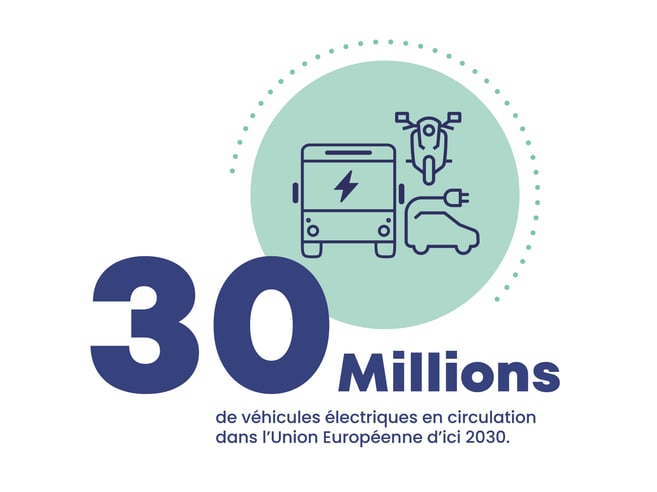
By 2030, 30 million electric vehicles could be on the road in the European Union. Faced with this increase, the industry needs to become more structured to respond to the growing volumes of batteries to be recycled in mainland France and the French overseas departments and territories.
What impact will European regulations have from August 2025?
From August 2025, electric vehicle batteries will be included in the Extended Producer Responsibility (EPR) scheme. This new European regulation sets ambitious targets. The aim? Accelerate the energy transition and optimize the collection and treatment of battery waste. For the management of batteries used in electric vehicles, the regulations include the following.
- Design
Declare the carbon footprint.
Incorporate a minimum percentage of recycled materials in the manufacture of new batteries, with a first stage providing for 16% cobalt, 85% lead, 6% lithium and 6% nickel (by 2031).
- Marketing
Affix a collection mark (Triman) from August 2025 and introduce a battery passport accessible via a QR Code (by February 2027).
- Collection and recycling
- Integrate the EPR sector: join an eco-organization, raise awareness, finance collection/recycling throughout France, make it mandatory to take back used batteries.
- Increase recovery rates: materials (65% by December 2025) and metals (90% for lead, copper, cobalt and nickel, and 50% for lithium, by February 2027).
These targets aim to reduce the environmental impact of batteries and secure the supply of raw materials for European industry.
Note: Batteries for light means of transport, such as electrically-assisted bicycles or electric scooters, belong to a separate category, subject to the MTL EPR (effective August 2025).
Find out more about the new European regulation →
Find out more about the EPR chain for light means of transport (LTM) →
How does Batribox support the players in the
in this transition?
As a major player in the collection and recycling of batteries, Batribox is preparing to integrate electric vehicle batteries into its operations, and is applying for future government approval to take over these regulatory obligations from car manufacturers. We are anticipating future developments with clear objectives:
- Facilitate compliance through personalized support.
- Optimize collection throughout the country.
- Develop solutions tailored to companies affected by the new regulations.
- Collaborate with specialized partners to ensure efficient, environmentally-friendly recycling.
- Implement concrete projects to facilitate the repair and second life of batteries.
Contact us today to find out more about our collection, second life and recycling solutions.
