All about Primary Batteries
Essential to our daily lives, batteries come in a variety of sizes, shapes, compositions and technologies, each with its own specific features. Discover how they work, their differences and the importance of recycling them.
What is a battery?
A battery, or disposable battery, is a small, portable generator that converts the energy of a chemical reaction into electricity. Unlike batteries (or accumulators), they are disposable and non-rechargeable.
How do batteries work?
A battery consists of two electrodes, a cathode (positive pole) and an anode (negative pole), immersed in a conductive solution.
When a conductive wire connects these electrodes to an electrical device, such as a light bulb, the circuit is closed. A current of electrons flows from one pole of the battery to the other, through the conductive solution. This generates electricity.
This electricity-generating process relies on the energy released by a chemical reaction. Once this reaction is complete, the battery is discharged and must be replaced.
What is a battery made of?

A stack is generally composed of the same elements, namely :
- Plastic.
- Paper (battery packaging).
- Various metals: zinc, iron, nickel, manganese...
Depending on the type of battery, the materials and other compounds are different.
What are the different types of batteries?

There are several types of battery, each based on a specific technology that influences both composition and use.
Salt batteries
Most contain zinc, carbon or manganese and an acid electrolyte (ammonium chloride, for example).
- Inexpensive.
- Use: energy-efficient devices (clocks, radios, remote controls, construction site lights, etc.).
Alkaline batteries
Made from steel, zinc, manganese and a basic electrolyte (mainly soda or potash).
- Low price (but more expensive than salt batteries).
- Use: low- to high-energy consumption devices (all-purpose). High-performance, they discharge less quickly if left unused for long periods.
Zinc-air batteries
Mainly made of zinc.
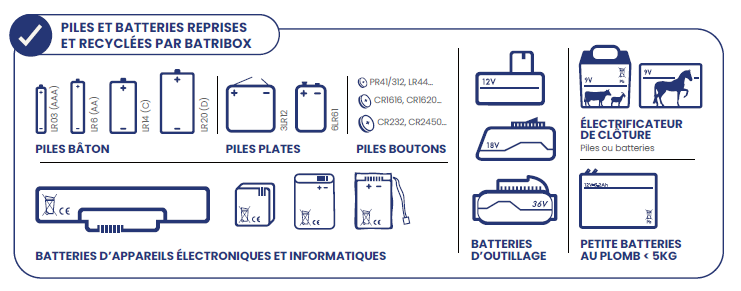
- Application: Characterized by their "button" shape (hearing aids, electric fences for livestock, in the most voluminous forms).
Organic lithium batteries
Made of steel, lithium and manganese (most often).
- Relatively expensive.
- Use: Lightweight, last 5 times longer than alkaline batteries.
- Good to know! For an equivalent voltage, lithium batteries are used half as much. More powerful, they deliver 3.5 V (vs. 1.5 V for alkaline batteries), reducing weight and bulk.
Inorganic lithium batteries
These contain steel, sulfur dioxide or thionyl chloride, lithium and a highly flammable organic electrolyte.
- Very high price, so not widely available for retail sale.
- Use: For military or highly technical applications.
Zinc-silver batteries
Made of steel, zinc and silver.
- Available mainly in "button" form.
- Use: small objects (watches, clocks, hearing aids, toys, electronic gadgets, etc.).
Mercury batteries
Contain steel, zinc and mercury.
- Available for sale in "button" form, for very specific and limited uses.
- Use: Old watches or clocks
What is a button cell?
The term "button cell" refers to a type of battery, not a technology. Used in small devices, they can be based on :
- Mercury (up to 25%, regulated use).
- Zinc-silver.
- Alkaline.
- Lithium-manganese (or organic lithium).
Did you know that ?